
The business case for a TMS fits on one page
Some software business cases are built on vague promises about efficiency. Luckily, for a TMS the calculation is concrete and simple to measure: A TMS is different: the savings sit in five specific processes, they're measured in minutes per order, and you can calculate them with numbers you already have.
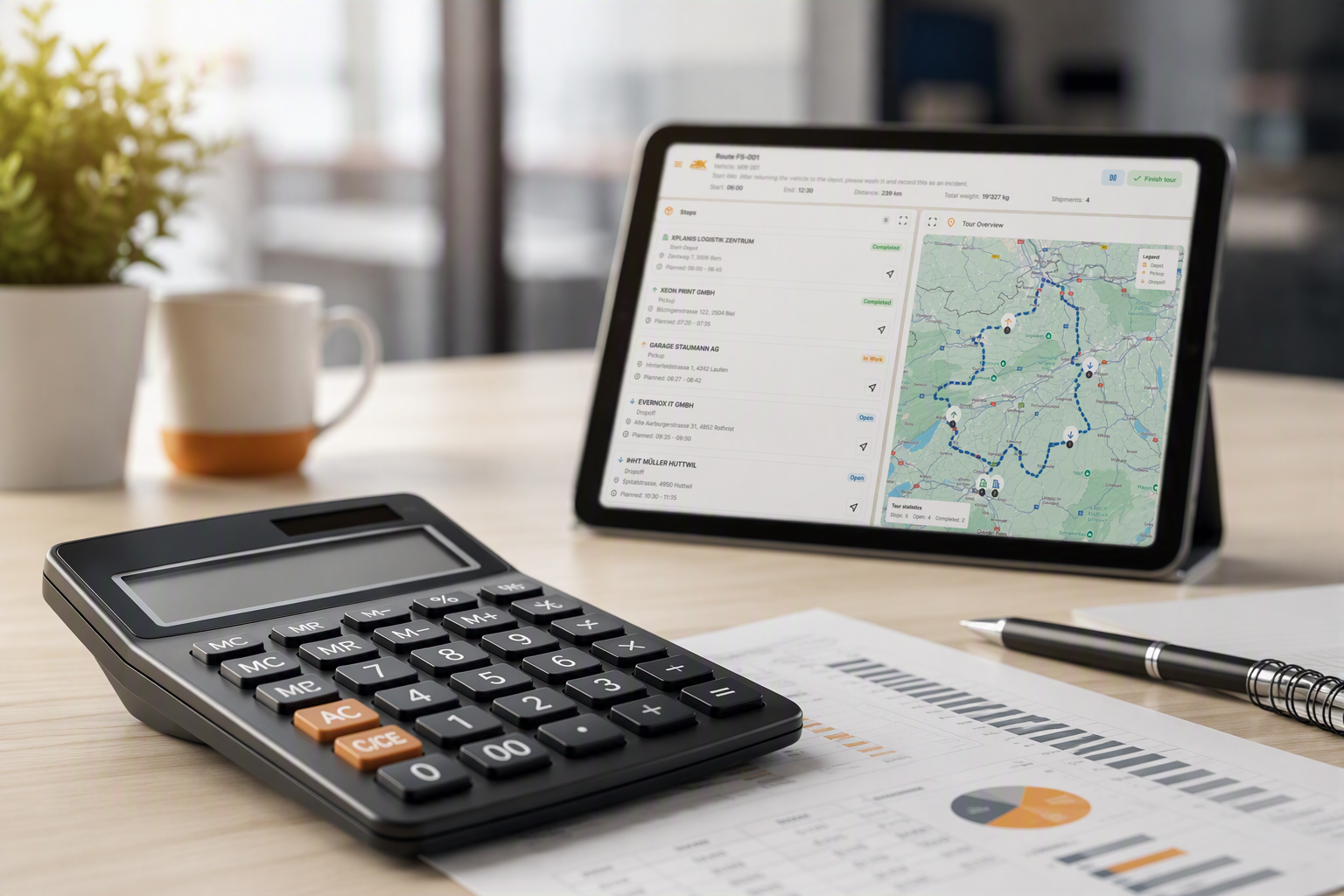
The savings are mechanical, not magical
A TMS doesn't create value through some emergent transformation of your business. It creates value by removing minutes from tasks and kilometers from tours. That's less exciting than "digital transformation", but it has a considerable advantage: you can count it. Break down what actually happens to a transport order in most operations, and you get five process areas:
- Order management. Orders arriving by email, phone, fax and portal, being retyped into a system. Address details being looked up and corrected. Customer data being captured manually. Every one of these is a manual step that a TMS with proper order intake and customer portal access can shorten or even remove.
- Dispatching. Building tours, assigning vehicles and drivers, reacting to changes. This is where a dispatcher's day actually goes, and it's where planning support — optimisation, availability views, drag-and-drop rescheduling — has the most leverage. A dispatcher who plans a tour in three minutes instead of five has just bought back multiple hours in a week.
- Documentation. Delivery notes, proof of delivery, signatures, photographs, damage reports. In paper-based operations this generates a second, entirely separate workflow: driver collects paper, paper travels back to the office, someone files it, someone else looks for it three weeks later when a customer disputes a delivery. Digital documentation collapses that chain.
- Execution. Vehicle-specific turn-by-turn navigation for the planned route, processing shipments. Poorly optimized tours mean unnecessarily driving kilometers, detours occur when road restrictions for the vehicles are not considered. The tour optimization respecting vehicle-specific requirements combined with a corresponding turn-by-turn navigation reduces the overall driven distance.
- Monitoring. Knowing where things stand without asking. Status tracking, exception alerts, customer notifications, synchronized in real-time between driver and dispatcher. The value here is partly time saved and partly problems caught early — the countable part is the time spent chasing information, as each call interrupts two people.
Five areas. Each with a measurable "before" state that you already know, because it's happening in your office right now.
The inputs you need are ones you have
Here's what makes the calculation tractable. To estimate what a TMS is worth to your operation, you need remarkably little:
- How many vehicles you run
- How many transport orders or tours you handle per day
- What a dispatcher hour costs you
- What a kilometer costs you (incl. the driver)
- What's the average distance you cover in a tour
- How long does it take you to process and to document an order
- How long does it take you to plan and to monitor a tour
The last two points are the only estimates, and they are estimates your dispatchers can make with reasonable accuracy — they're the ones doing it. Gather these numbers, and you have the starting point for your calculation.
Calculate your savings potential
Rather than ask you to take any of this on trust, we've built the calculation into a tool. With more than 40 years of experience in digital transport management, we have generated a thorough understanding of the savings potential that typically materialises for customers of our X4fleet TMS. To make things simple for you, we put together a calculator, which calculates your specific savings potential based on your very own data. It's arithmetic, not prophecy. The result is typically larger than people expect, as the savings scale with your operation: Two minutes saved on order intake sounds trivial, but at 120 orders a day across 250 working days, you save 1'000 hours a year. On top of that, save 5km on your 100km tours through route optimisation, and your fleet of 50 vehicles save you more than 60'000 km in a year.
Deduct the license cost for the TMS and you'll see the savings that reach your bottom line. We price X4fleet per vehicle and month. No setup fee, no upfront licence fee, no maintenance fee. That's partly a commercial position — we believe that we should earn our money when our software brings value to your operation — but it's also what makes the ROI calculation clean. When the cost side is a single predictable monthly figure that scales with your fleet, you can put it directly next to the savings figure and see what's left. You'll notice that the license cost is dwarfed by the savings potential.
What the calculation won't tell you
Two caveats, because a business case built on overclaiming falls apart on contact with reality.
First, the savings don't arrive on day one. A TMS delivers its value once people are using it properly, once the master data is clean, and once the processes have adapted. That usually takes a couple of months. A realistic business case discounts the first year.
Second, the biggest benefits are often the ones the calculator doesn't count. Fewer delivery disputes because proof of delivery is instant and searchable. Better customer retention because you can answer "where is my shipment" in seconds. The ability to take on more volume without adding dispatchers. These are real, they're frequently larger than the process savings, and they're too operation-specific to model generically. We've deliberately left them out. A business case that only counts what it can defend is a business case that survives the CFO's questions.
Want to walk through the numbers for your operation with someone who's done it before? Talk to us.